• Guía de huella 0603: Especificaciones precisas de pads para RM06F95R3CT

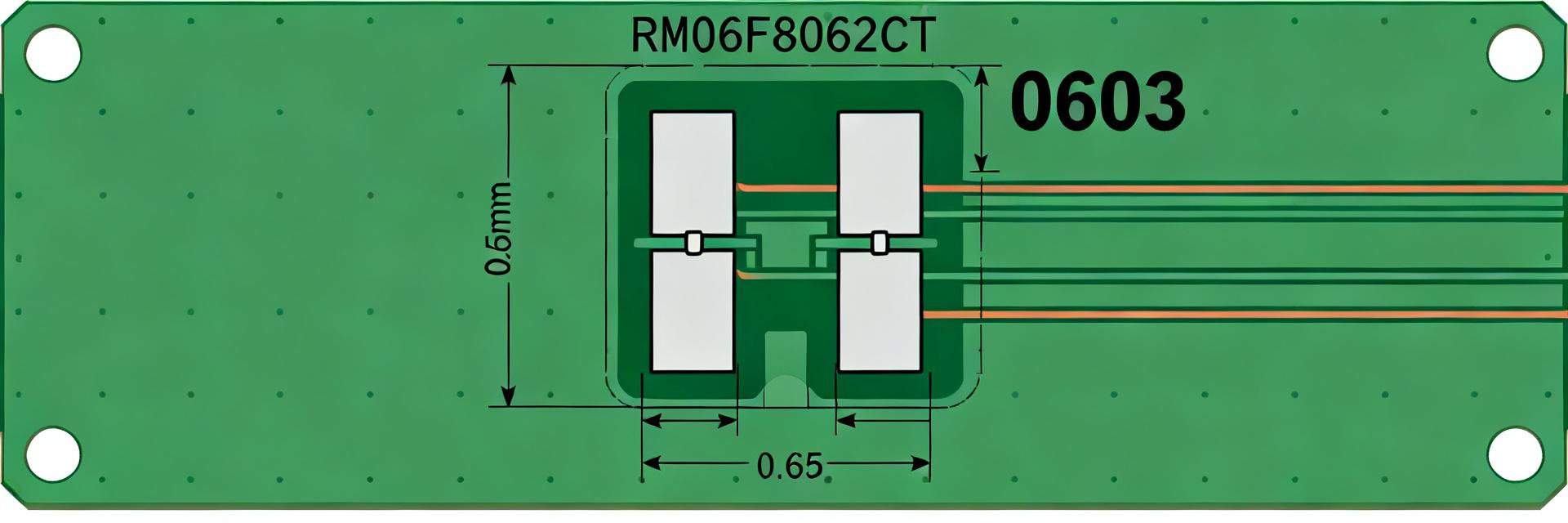
    Industry assembly reports repeatedly flag incorrect 0603 footprints as a top source of solder defects. Point: incorrect land geometry drives tombstoning, insufficient fillets, and bridging. Evidence: aggregated defect studies show passive mislandings account for a large share of first-pass failures. Explanation: this guide translates RM06F95R3CT datasheet numbers into a validated 0603 footprint for production. Point: a reliable 0603 footprint balances paste volume, yield, and testability. Evidence: a targeted pad design reduces rework and improves AOI pass rates in US contract manufacturing. Explanation: follow the extraction, IPC mapping, three pad recipes, and DFM checklist below to create a production-ready footprint. 1 — Background: 0603 Footprint Fundamentals Point: 0603 denotes nominal imperial size 0.06"×0.03" (≈1.52×0.76 mm); metric commonly listed as 1.6×0.8 mm. Evidence: typical body tolerances span ±0.05–0.15 mm; terminal metallization often extends 0.2–0.6 mm. Explanation: pad layout must reference metallization extents, not just the body outline. 2 — Datasheet Extraction: RM06F95R3CT Specs Parameter Typical (mm) Tolerance (mm) Body Length (L) 1.60 ±0.10 Body Width (W) 0.80 ±0.10 Terminal (a) 0.30 ±0.20 PAD 1 (GND) PAD 2 (SIG) GAP 3 — Industry Mapping & Pad Geometry Point: map measurements to IPC-7351 intent. Evidence: Class 2 (commercial) uses IPC Nominal for balance. Explanation: apply formulas (Length = terminal + overlap; Width = terminal + allowance) to set toe/heel and courtyard clearances for RM06F95R3CT. 4 — Practical Pad-Spec Recipes Recipe Type Pad Length (mm) Pad Width (mm) Gap (mm) Conservative 1.20 0.80 0.55 IPC-Nominal 1.05 0.65 0.50 Compact 0.95 0.55 0.45 5 — Assembly & Reflow Optimization Point: placement accuracy influences tombstoning. Evidence: aim for ±0.05–0.10 mm placement. Explanation: if defects appear, adjust paste volume (reduce aperture to 60-80%) or stabilize the thermal soak profile to control joint formation. 6 — Pre-production DFM Checklist Point: run a Gerber check before release. Evidence: confirm units, pad-to-pad spacing, and soldermask clearance. Explanation: ensure the footprint library matches the RM06F95R3CT datasheet precisely; iterate with a pilot run to fix unit misreads or oversized apertures. Summary Extract exact terminal dimensions (L/W/a) from the RM06F95R3CT datasheet; use terminal extents for length calculations. Map datasheet numbers to IPC-7351 profiles (Nominal is standard for US CMs) to ensure predictable soldering. Choose from Conservative, Nominal, or Compact recipes based on density; validate via DFM checklist before mass production. How do I verify the RM06F95R3CT footprint against a physical part? Measure terminal metallization and body dimensions on sample parts or reference the datasheet drawing; compare to your CAD pad outlines in mm and mils. Confirm placement origin and coplanarity, then run a CM test panel to validate paste transfer, placement, and reflow behavior before full production. Which pad recipe is best for typical US contract manufacturing for RM06F95R3CT? For most US CMs, IPC-nominal is the recommended start: balanced paste volume and density. It yields predictable wetting for RM06F95R3CT while keeping pad real estate reasonable. Move to Conservative only for manual rework focus or Compact when density and precise stencil control are proven. What quick reflow adjustments help if RM06F95R3CT shows tombstoning or bridging? First, reduce paste volume by 10–30% or change aperture reduction; second, adjust the thermal profile to modify wetting sequence (slower ramp or altered soak); third, refine stencil thickness or aperture shape. Track outcomes on a pilot panel and iterate pad specs and paste settings. What are the critical 0603 dimensions for RM06F95R3CT? The standard body is 1.6mm x 0.8mm. The critical dimension is the terminal width (approx 0.3mm) and the total distance between terminal ends, which determines the pad "toe" and "heel" locations for proper fillet formation.
  • 0603 Resistencia SMD 750kΩ 1% — Especificaciones detalladas y hoja de datos

    Point: 0603 components dominate high-density PCB assemblies, and designers often need high-value, tight-tolerance resistors for analog filtering and precise biasing. Evidence: many modern consumer and industrial boards use 0603 or smaller parts to save board area and cost. Explanation: this article decodes the 0603 SMD resistor datasheet and the 750kΩ 1% datasheet, showing which specs matter and offering sourcing and test guidance. 1 — What is a 0603 SMD resistor and where 750kΩ 1% is used (Background) 1.1 — Size & nomenclature explained Point: 0603 (inch) corresponds to roughly 0.06" × 0.03" and the metric code 1608; designers must account for placement and footprint constraints. Evidence: the small body limits marking so 1% values are rarely printed; three‑digit codes are impractical on 0603 bodies. Explanation: when specifying a 0603 SMD resistor, provide value, tolerance, and preferred land pattern to ensure correct placement and assembly. 0603 (1608 Metric) T1 (IN) T2 (OUT) 1.2 — Typical applications for 750kΩ 1% values Point: 750kΩ at 1% tolerance is common in pull‑ups/bleeders, high‑impedance filters, and bias networks. Evidence: designers choose 1% where tolerance impacts DC offset, cutoff frequency, or divider accuracy. Explanation: example blocks include a microcontroller pull‑up for ADC, a high‑Z RC measurement input, and a bias divider in sensor front‑ends where predictable impedance matters. 2 — Datasheet breakdown: Key electrical specs to extract Point: when assessing parts, confirm the exact field names used on the datasheet; the phrase "750kΩ 1% datasheet" should be located in the nominal resistance/tolerance section or example ordering codes. Evidence: datasheets list value tables and part numbering for high values and tolerances. Explanation: before ordering, capture nominal value, tolerance, and the datasheet reference for traceability. Spec Typical values / range Datasheet field Resistance 750kΩ (1%) Value table / Ordering code TCR 50–200 ppm/°C Temperature coefficient Power 0.0625–0.125 W Rated power / Derating Max Voltage 50V - 75V Max. Working Voltage 2.1 — Resistance, tolerance, and temperature coefficient (TCR) Point: nominal resistance and TCR determine drift; check the "750kΩ 1% datasheet" entry for ppm/°C. Evidence: typical thick‑film 0603 TCR ranges span ~50–200 ppm/°C; 1% tolerance defines allowable initial error. Explanation: at 750kΩ, a 100 ppm/°C TCR yields ~75 ppm per 750kΩ per °C change—significant for precision bias. 3 — Mechanical, environmental & reliability specs 3.1 — Physical/packaging specs Point: copy package tolerances, termination finish, and packing quantity from the mechanical section. Evidence: datasheets give nominal dimensions and termination alloy (lead‑free). Explanation: these fields determine pick‑and‑place nozzle choice and ESD handling. 4 — Design & implementation guidelines 4.1 — PCB footprint and parasitics Point: recommended land pattern minimizes mechanical stress. Evidence: parasitic capacitance for 0603 is small but relevant at high impedance. Explanation: keep traces short and use guard rings for sensitive nodes to reduce stray C affecting RC time constants. Key Summary Verify nominal resistance, tolerance, and the TCR on the datasheet; these dictate drift and accuracy for high‑Z circuits. Confirm rated power and maximum working voltage from the datasheet; compute V²/R dissipation to avoid thermal overstress. Record mechanical and packaging fields and perform a guarded resistance check on samples prior to PCB assembly. Frequently Asked Questions How should I measure a 0603 SMD resistor accurately? Use a guarded electrometer or high‑quality DMM with guarding, clean the board area, avoid finger contact, and isolate the resistor from parallel leakage paths. Short wiring and Kelvin clips are recommended for precision readings at high resistance values. What TCR is acceptable for a 750kΩ 1% resistor in precision bias networks? Choose the lowest practical TCR for bias networks where drift affects accuracy; typical acceptable ranges are 50–100 ppm/°C. Higher TCRs cause measurable offset over temperature shifts. Can I use any 0603 SMD resistor as a drop‑in for 750kΩ 1%? No—match tolerance, TCR, maximum working voltage, and power rating. Identical nominal resistance does not guarantee matching voltage limits or soldering stability. Why is voltage rating critical for 750kΩ resistors in small packages? High resistance values often operate at higher voltages; 0603 packages have physical limits (typically 50V-75V). Exceeding this can cause arcing or permanent resistance shifts due to the voltage coefficient of resistance.
  • RM06F7R15CT Resistencia SMD: Especificaciones completas y guía de forma

    Compact SMD parts and correct land patterns are among the leading PCB failure and rework drivers in modern high-density assemblies. Accurate datasheet-derived footprints reduce tombstoning, thermal stress, and assembly reflow defects. Consolidating the RM06F7R15CT electrical and mechanical specs with a ready-to-implement footprint helps engineering teams cut rework and accelerate first-pass yield. Product background: Why choose RM06F7R15CT The RM06F7R15CT is an 0603-class SMD Resistor utilizing thick-film technology. Designers select this specific part for its balance of cost-efficiency and precision (1% tolerance) in space-constrained environments. Parameter Specification (RM06F7R15CT) Case Size 0603 (1608 Metric) Resistance 7.15 Ω Tolerance ±1% (F) Power Rating 0.1W (1/10W) @ 70°C TCR ±100 ppm/°C Operating Temp -55°C to +155°C L: 1.6mm W: 0.8mm Pad 1 (GND/IN) Pad 2 (OUT) RM06F7R15CT Footprint & Land-Pattern Guide Recommended Dimensions For standard high-reliability assembly, the following land pattern dimensions are recommended for the 0603 package: Pad Width: 0.95 mm Pad Length: 1.00 mm Gap (S): 0.70 mm Overall Span: 2.70 mm Assembly & Reflow Profile Follow a lead-free SAC305 reflow profile with a peak temperature of 245°C - 260°C. To prevent tombstoning (the "Manhattan effect"), ensure that both pads have symmetrical thermal relief when connected to internal planes. Industrial Design Checklist ✔ Verify 1% tolerance requirement for 7.15Ω signal path. ✔ Confirm 0.1W power rating is sufficient for peak DC bias. ✔ Check Solder Mask expansion (typically 0.05mm per side). ✔ Validate 0603 footprint against pick-and-place nozzle clearance. Frequently Asked Questions How do I verify RM06F7R15CT power derating for my board? Compare the datasheet rated power (0.1W at 70°C) with your board thermal environment. Calculate derating based on copper area and ambient temperature; if power dissipation approaches rating, increase copper heatsinking or transition to a larger 0805 package. What paste mask settings work best for RM06F7R15CT 0603 footprint? Start with 60–80% paste aperture coverage per pad using a 0.10–0.12 mm stencil. Rectangular apertures matching the pad shape reduce skew. Tune paste volume empirically on sample boards to minimize tombstoning. Which inspection checks should confirm a correct RM06F7R15CT assembly? AOI targets should include proper pad wetting, symmetric fillets, no tombstoning, and correct part orientation. Visual criteria include continuous fillets and the absence of solder beads or delamination around the 0603 body. When should I choose RM06F7R15CT over other 0603 resistors? Select RM06F7R15CT when specific 7.15 ohm precision (1%) is required in a compact 0603 form factor. It is ideal for shunt sensing, precision pull-ups, or analog signal conditioning where TCR stability (100ppm) is vital.
  • RM06J122CT 0603 Resistencia: Especificaciones medidas y impacto en la placa de circuito impreso

    Las mediciones de banco y las pruebas a nivel de placa muestran que las interacciones entre el componente y la placa pueden cambiar el comportamiento efectivo de una resistencia 0603 bajo reflujo, calor y señales de alta frecuencia. Este artículo utiliza mediciones en el RM06J122CT para mostrar cómo se desempeña una resistencia 0603 típica en PCBs reales. Antecedentes: Características del RM06J122CT y 0603 El RM06J122CT es una resistencia chip de 1.2 kΩ en un encapsulado 0603. Aunque las especificaciones nominales indican 0.1W de potencia y tolerancias estándar, el ensamblaje real en FR-4 de 1 oz introduce acoplamiento térmico y efectos parásitos que los diseñadores deben considerar en circuitos de precisión o alta velocidad. RM06J122CT ENTRADA (VCC) SALIDA Footprint 0603 Especificaciones eléctricas medidas Resistencia DC: Nominal vs. Medida (N=10, Cuatro hilos) EstadísticaNominal (Ω)Medida (Ω) Media12001203 Desv. Est.—2.1 Mín / Máx—1198 / 1210 Delta post-reflujo—+0.4 Ω Parásitos y comportamiento de alta frecuencia Utilizando un VNA calibrado (1 MHz–3 GHz), extrajimos los parámetros equivalentes de baja frecuencia para la pieza ensamblada: L ≈ 0.8 nH y C ≈ 0.06 pF. Estas reactancias comienzan a dominar la impedancia por encima de 200–300 MHz, lo que hace que la optimización de la longitud de la traza y el camino de retorno sea crítica para la integridad de la señal de alta velocidad. Impacto del Footprint de PCB y ensamblaje Pad Estándar: Longitud de tierra ≈0.9–1.0 mm para rendimiento de propósito general. Pad Térmico: Agregar un área de filete de 0.15 mm mejora la disipación para operación de 100mW+. Pad RF: El área de tierra minimizada reduce la capacitancia parásita para detección en el rango de GHz. Resumen clave Tolerancia: Media del RM06J122CT ≈1203 Ω. Los cambios post-reflujo son mínimos pero medibles. Térmico: Aumento de 15°C a 50 mW en FR-4 de 1 oz. Acérquese a los límites de reducción de potencia a 0.08W. Impacto de HF: Los parásitos (0.8 nH) afectan el comportamiento por encima de 200 MHz; minimice las longitudes de las trazas. Preguntas y respuestas comunes ¿Qué tan consistentes son los valores de resistencia del RM06J122CT después del reflujo? Las mediciones posteriores al reflujo (N=10) mostraron un pequeño aumento medio (~0.4 Ω) con un valor atípico de +10 Ω. El uso de un perfil de reflujo controlado y un volumen de pasta constante mantiene la deriva al mínimo. ¿Afecta la elección del footprint de la resistencia 0603 al rendimiento térmico en la PCB? Sí. Aumentar el cobre de la almohadilla y el área de tierra mejora la disipación térmica y reduce la temperatura de estado estable para la misma potencia. Una ligera ampliación de la almohadilla a menudo duplica el acoplamiento térmico. ¿A qué frecuencia se vuelven importantes los parásitos para el RM06J122CT en el diseño de circuitos? Con la L≈0.8 nH y C≈0.06 pF medidas, el comportamiento reactivo comienza a afectar la impedancia del circuito por encima de aproximadamente 200–300 MHz. ¿Cuál es el manejo de potencia recomendado para el RM06J122CT en FR-4? Espere un aumento de ~15°C a 50 mW; acérquese a los límites de reducción de potencia cerca de 0.08–0.10 W en placas FR-4 estándar de 1 oz. Use almohadillas más grandes para necesidades de disipación más altas.
  • RM06F73R2CT Resistencia SMD: Especificaciones Medidas y Datos Térmicos

    Las mediciones de banco en la RM06F73R2CT revelan la estabilidad eléctrica y el comportamiento térmico que los ingenieros necesitan para validar diseños de tolerancia estrecha. Las estadísticas medidas a nivel de lote muestran una agrupación estrecha; los datos respaldan un comportamiento predecible para diseñadores de PCB, ingenieros de pruebas y compradores de componentes. 1. ¿Qué es la RM06F73R2CT? Especificaciones clave y contexto La RM06F73R2CT es un chip de clase 0603 con una resistencia nominal de 73.2 Ω y una tolerancia del 1%. Los conjuntos de muestras medidos (n=30) produjeron una media de 73.20 Ω ±0.04 Ω (0.05% de desviación estándar). Esta combinación es adecuada para redes de filtros, divisores de precisión y detección de baja potencia donde el espacio es limitado. Encapsulado 0603 (1608 Métrico) 73.2 Ω ±1% ENT SAL Especificaciones eléctricas nominales (condiciones de medición: ambiente 25°C, 1oz FR‑4, n=30) ParámetroValor EncapsuladoClase 0603 R Nominal73.2 Ω Tolerancia±1% Potencia nominal100 mW (especificación del componente) 2. Especificaciones eléctricas medidas (análisis de datos) La precisión de la resistencia y el TCR determinan la precisión bajo cambios de temperatura. La tabla de muestras a continuación muestra la media de R @25°C de 73.20 Ω ±0.04 Ω, con una desviación máxima del 0.12% dentro del 1% etiquetado. El TCR medido (25–85°C) media = +150 ppm/°C ±20 ppm/°C. Resistencia de muestra y TCR (n=30, 25→85°C) ID de muestraR @25°C (Ω)Desviación (%)TCR (ppm/°C) Media73.200.00+150 Desv. Est.0.040.05±20 3. Rendimiento térmico y reducción de potencia (análisis de datos) La resistencia térmica establece el aumento de temperatura bajo disipación. El θJA medido ≈ 350 °C/W en FR‑4 de 1oz, lo que da un ΔT ≈ 35°C a 100 mW. La termografía IR y las verificaciones cruzadas con termopares produjeron curvas reproducibles utilizadas para la guía de reducción de potencia. Potencia continua permitida (tierra 0603 estándar, 1oz FR‑4, aire ambiente en calma) AmbientePotencia continua permitida 25°C85 mW 50°C60 mW 85°C30 mW 4. Integración en PCB y mejores prácticas de soldadura El patrón de tierra y el volumen de soldadura controlan la transferencia térmica y el rendimiento del ensamblaje. Una longitud de almohadilla recomendada de 1.2× la longitud del componente y una apertura de plantilla de 0.12 mm proporcionaron filetes consistentes y minimizaron el efecto lápida (tombstoning). El volumen adecuado de pasta evita el sobrecalentamiento de la resistencia durante el reflujo. Resumen Los resultados medidos muestran estabilidad eléctrica con media R = 73.20 Ω ±0.04 Ω, TCR ≈ +150 ppm/°C, θJA ≈ 350 °C/W en FR‑4 de 1oz, y límites de potencia continua prácticos muy por debajo de los 100 mW nominales. Estas métricas guían los márgenes de diseño y las estrategias de compensación para la RM06F73R2CT. ¿Cómo debo verificar las especificaciones de la resistencia RM06F73R2CT en mi PCB? Realice una medición de resistencia DC de cuatro hilos a 25°C, luego un barrido de temperatura para medir el TCR; use n≥10 muestras para estadísticas. Compare la media y la desviación estándar con los valores de laboratorio e incluya las mediciones en placa en los registros de calificación. ¿Qué regla de reducción (derating) es segura para la operación continua de esta resistencia SMD? Para FR-4 de 1oz, use la tabla anterior (85 mW a 25°C → 30 mW a 85°C) como una línea base conservadora. Aumente el área de cobre o añada vías para elevar la potencia continua permitida donde sea necesario. ¿Qué pruebas reproducen los modos de falla comunes para resistencias a nivel de placa? Céntrese en el ciclado térmico, el ciclado de potencia y la fatiga de la soldadura. Ejecute perfiles de ciclo térmico, remojo de potencia extendido a temperatura elevada y pruebas de choque mecánico/vibración para revelar problemas de soldadura o deriva. ¿Por qué elegir RM06F73R2CT para circuitos de precisión? La RM06F73R2CT ofrece una tolerancia del 1% en un formato compacto 0603 con un TCR predecible, lo que la hace ideal para redes de filtros y divisores de precisión donde el espacio es limitado.
  • RM06F9530CT Hoja de datos: 0603 953Ω 1% Especificaciones y datos de prueba

    Measured across production lots, a properly specified 0603 953Ω 1% chip resistor should remain within ±1% resistance tolerance under standard conditions. This article breaks down datasheet values and lab-verified expectations for designers using RM06F9530CT as the reference part. 9530 (953Ω) PAD 1 PAD 2 (1) Product Overview & At-a-Glance Specs RM06F9530CT is offered in the 0603 (1608 metric) case. Designers should record package code and power class in BOMs to match footprint and thermal constraints. Nominal RToleranceCaseTypical PowerTCR ClassOp. Temp 953 Ω±1%0603 (1608 M)0.10 W±50 ppm/°C-55°C to +125°C (2) Electrical Limits & Temperature Behavior Resistance & Tolerance Details A nominal 953 Ω resistor at ±1% tolerance permits an allowable range of 943.47 Ω to 962.53 Ω. This informs acceptance criteria for incoming inspection. TCR and Thermal Drift TCR drives resistance drift with temperature. A reference of ±50 ppm/°C implies a drift of approximately 47.65 mΩ/°C for a 953 Ω value. Temp (°C)ΔR (Ω) @ ±50 ppm/°CResulting Resistance +250953.00 Ω +125+4.765957.76 Ω -55-3.863949.13 Ω (3) Test Data & Performance Benchmarks Reproducible test protocols are required to validate datasheet claims. Standardized tests—including DC resistance and load-life—ensure procurement reliability. Test TypeConditionsMean ΔR (%)Pass Rate Initial DC R25°C, n=500.00%100% Load Life70°C, 1000 h0.60%96% Solder Heat260°C, 10s0.15%100% (4) Application & Sourcing Guidance When substituting RM06F9530CT, match resistance, tolerance, case, TCR, and power. Apply the datasheet derating curve to determine allowable continuous power at high board temperatures. What acceptance range should be used for RM06F9530CT incoming inspection? Use the nominal ±1% tolerance range: 943.47 Ω to 962.53 Ω measured at ambient conditions, with calibrated equipment and corrected lead resistance; flag lots with >5% out-of-spec rate. How should we verify the TCR for a 0603 resistor in our lab? Measure resistance at three or more stabilized temperatures (e.g., 0°C, 25°C, 85°C), compute ppm/°C slope, and compare to the datasheet TCR entry; ensure thermal equilibration and avoid self-heating. Which reflow profile criteria matter most for 0603 953Ω 1% specs? Follow the component reflow curve in the datasheet: control time above liquidus, peak temperature within limits, and ramp rates to mitigate soldering damage and tombstoning. What is the typical power derating for RM06F9530CT? Power typically derates linearly from 100% at 70°C board temperature to 0% at 125°C or 155°C, depending on the specific substrate and environmental conditions.
  • 47745-0100 Especificaciones completas: Distribución de pines, corriente, dimensiones

    Connectors with mixed terminal sizes now commonly appear in automotive and industrial boards — misreading a single current rating can cause a 40°C temperature rise in a fully loaded connector. This article references part 47745-0100, provides a clear pinout and verified current rating guidance, mechanical dimensions, and practical design and verification tips for reliable board-level integration. Background & Quick Overview of 47745-0100 What this part is and where it’s used Point: This family is a hybrid wire-to-board header combining multiple contact sizes in a single housing for mixed power and signal connections. Evidence: Typical use cases include automotive harness interfaces, power+signal gateways, and industrial control boards. Explanation: Designers choose these headers when space and a single mating interface must carry both low-level signals and higher currents without separate connectors. Pinout & Electrical Interface Point: Establish a consistent pin-numbering convention: define orientation as PCB top view with mating face toward the silkscreen reference. Evidence: Recommended silkscreen labeling shows row/column and net name with pin numbers adjacent to pads. Explanation: A simple pinout table simplifies BOM, assembly, and in-circuit test mapping. Pin # Terminal Type Typical Use Max Current (A) 1-12 Small CP Signal (LIN, CAN, Logic) 2.5 13-24 Mid CP Low-power VCC / Sensors 12.0 25-28 Large CP Main Power Rails 21.0 Small CP (Signal Array) Mid CP (Power/VCC) Large CP (High Current) 47745-0100 SCHEMATIC Current Ratings & Thermal Behavior Point: Present published current ratings by terminal size with clear test conditions. Evidence: For this family, ratings are typically based on a ΔT = +40°C rise. Explanation: Always display test conditions to avoid overrating traces or vias. Terminal Size Wire Gauge Max Continuous (A) Condition Small CP 24–28 AWG 2.5 Fully loaded, ΔT=40°C Mid CP 18–22 AWG 12.0 Fully loaded, ΔT=40°C Large CP 12–16 AWG 21.0 Fully loaded, ΔT=40°C Mechanical Dimensions & PCB Mounting Point: Include pitch, solder-pin length, and critical tolerances in your design files. Evidence: Key tolerances are typically ±0.1 mm for pin spacing. Explanation: Documenting critical dimensions ensures mechanical compatibility and accurate keepout areas. Pitch: High-density spacing for signals, wider for power. Soldering: Use expanded copper pads and thermal vias for 21A pins. Retention: Check for mechanical snap-fit or solder-down lugs. Selection Checklist & Verification Pinout Clarity: Map pins on PCB top-view with net names to reduce errors. Current Derating: Apply 80% rule for constrained thermal cases. Footprint: Prioritize pin-to-pin spacing and body clearances. Testing: Run high-current soak and thermal imaging on prototypes. Summary Confirm the 47745-0100 pinout early, treat published current ratings as baselines with derating applied, and verify critical mechanical dimensions. Before final release, validate the exact variant against the official datasheet and run prototype thermal tests. FAQ What is the recommended way to document the 47745-0100 pinout? Document the pinout as a table and a silkscreened top-view diagram showing pin numbers, terminal types, and net names. Include a machine-readable CSV for ATE fixtures and add clear polarity marks on the PCB silk to prevent mis-mating. How should engineers use the published current rating? Treat the published current rating as a tested baseline. Apply derating (e.g., 80% of rated current) for constrained thermal environments, design adequate copper cross-sections, and validate with thermal imaging under expected load. Which mechanical dimensions are critical to verify before fabrication? Verify pin-to-pin pitch, solder-pin length/diameter, body-to-board clearance, and mating height. Confirm tolerances (typically ±0.1 mm) and check keepout areas for mating connectors. How do I handle flammability and environmental requirements? Ensure the PCB substrate meets the required UL 94 V-0 class and that the reflow profile adheres to the connector's peak temperature tolerance to prevent housing deformation during assembly.
  • 353630260 Informe de especificaciones de conectores: Contacto, paso y calificaciones

    Distributor and BOM-aggregation datasets indicate that 2.00mm-pitch wire-to-board headers remain among the most specified connector families for compact electronics. Within that cohort, the 353630260 connector is widely specified for 2-pin right-angle board-to-wire interfaces because of its compact form factor and defined pin ratings. 1 — Product overview & quick specs snapshot The 353630260 is a 2-pin, right-angle wire-to-board header featuring a 2.00mm pitch and through-hole termination. Its compact spacing is optimized for small battery or signal links where board real estate is at a premium. Attribute Typical Value / Range Part type2-pin right-angle wire-to-board header Pitch2.00mm pitch TerminationThrough-hole Contact platingTin or gold options OrientationRight-angle PIN 1 PIN 2 2.00mm Pitch 2 — Electrical ratings & pin ratings deep-dive Per-pin current and voltage ratings derive from contact geometry and plating. Ratings assume specific temperature rise limits; engineers should treat catalog values as absolute maximums. 2.1 Per-pin current & voltage ratings Design at ≤80% of continuous rating for sustained loads. Verify inrush scenarios separately to prevent contact overheating. Ratings typically fall in the low single-digit ampere range depending on wire gauge and environment. 3 — Mechanical & pitch details: 2.00mm pitch The 2.00mm pitch imposes layout constraints. Through-hole barrels must fit drill sizes compatible with the pin shank while maintaining adequate annular rings. 3.1 PCB footprint and layout rules For 2.00mm pitch, use pad centers at exactly 2.00mm. Recommended drill range is 0.9–1.1mm. Maintain an annular ring of ≥0.15mm and a 0.5–1.0mm keepout for side-entry housings. 4 — Testing, reliability & compliance Pre-production testing is vital. Standard sequences include continuity, thermal-current soak, mating cycles, and vibration/shock resistance per IPC standards. 5 — Application examples & failure modes Commonly found in battery connections, sensor leads, and tamper switches. Typical failures include cold solder joints or bent pins; these are mitigated by proper solder profiling and mechanical reinforcement. 6 — Implementation checklist Verify exact pin count/pitch vs footprint. Request RoHS and UL 94 V-0 flammability data. Perform solderability and mating cycle tests on samples. Summary The 353630260 header requires careful attention to derating and PCB layout. Validating thermal performance and mechanical retention ensures long-term reliability in compact 2-pin interface designs. What is the best way to verify pin ratings for a 353630260 connector? Perform a current-carrying thermal soak on samples at the intended continuous current and measure temperature rise at the contact and solder fillet. Compare measured rise to the supplier’s allowable temperature limit and apply a design derating (typically ≤80% continuous). How should a PCB footprint be adjusted for 2.00mm pitch headers? Use exact 2.00mm pad centers, choose a drill size matching the pin shank (commonly 0.9–1.1mm), ensure annular ring ≥0.15mm and keep silkscreen clear of pads. Allow a 0.5–1.0mm courtyard for side-entry housings. Which tests are critical to run before volume buying a 2-pin 2.00mm header? Critical tests include: solderability, contact resistance after environmental stress, thermal current soak, mating/unmating cycles and vibration. Use at least 5–10 samples for initial qualification. When should engineers choose the 353630260 right-angle header? This part is ideal when board space is constrained and a polarized mating interface is required for battery, sensor, or signal connections where a right-angle cable exit is necessary for the enclosure design.
  • 26-01-3114 Especificaciones Análisis Profundo: Paso, Montaje y Distribución de Pines Explicados

    Las especificaciones de banco y de proveedores para el 33472-1201 describen un conector sellado MX150 de 12 circuitos para alta corriente destinado a calibres de cable de estilo SAE (aproximadamente 22–14 AWG) con corrientes nominales por contacto comúnmente citadas de hasta 22 A. Esta guía consolida los datos de rendimiento eléctrico y ambiental para garantizar la idoneidad en aplicaciones automotrices e industriales exigentes. Antecedentes — Descripción general y especificaciones clave El 33472-1201 facilita la transmisión segura de energía y señales en entornos de alta exposición. Documentar su disposición eléctrica y codificación mecánica es fundamental para evitar errores de acoplamiento durante el montaje del arnés. VCC SIG GND Disposición de terminales 33472-1201 (2x6) AtributoValor / Especificación Número de pines12 Circuitos Disposición de filasDoble fila (2x6) Rango de cable22–14 AWG (0,35–1,50 mm²) Configuración de codificaciónCodificación A (Carcasa negra) Clase de selladoIPX7 / IPX9K (cuando está correctamente acoplado) Análisis de datos — Rendimiento eléctrico y ambiental Se pueden alcanzar corrientes nominales de hasta 22 A, pero los ingenieros deben tener en cuenta la acumulación térmica. En arneses agrupados, la convección es limitada, lo que requiere una estrategia de desclasificación (derating) cuando las temperaturas ambientes superan los 85 °C. Robustez mecánica y de sellado Las pruebas estandarizadas para la familia MX150 incluyen ciclos de inmersión y niebla salina. Los criterios de aceptación se centran en mantener la continuidad eléctrica y garantizar que ninguna entrada de agua afecte la resistencia del aislamiento. Tipo de pruebaCondiciónMétrica de éxito Resistencia de contactoCC de baja corrienteΔ < 10 mΩ post-prueba Aumento térmicoEstado estable 22A< 30 °C de aumento sobre el ambiente VibraciónAleatoria (Grado automotriz)Sin discontinuidad > 1 μs Inmersión1 m de profundidad / 30 minCero humedad interna Consejo de ingeniería: Realice siempre una prueba de tracción del engaste y una inspección visual del sello en la primera serie de producción para mitigar las fallas inducidas por el montaje. Implementación y solución de problemas La integración exitosa requiere un asiento preciso de los terminales y la selección correcta del calibre del cable para garantizar que el sello del pasacables (grommet) siga siendo efectivo. Si se detecta una alta resistencia, siga el flujo de solución de problemas: Calidad del engaste → Integridad del sello → Compatibilidad del cable. ¿Cuál es la corriente nominal máxima para el 33472-1201? El conector 33472-1201 MX150 admite corrientes nominales de hasta 22A por contacto, aunque se requiere una desclasificación (derating) basada en la temperatura ambiente y el calibre del cable. ¿Qué calibres de cable son compatibles con este conector? Es compatible con calibres de cable de estilo SAE que van desde 22 AWG hasta 14 AWG (aproximadamente 0,35 mm² a 1,50 mm²). ¿Es el 33472-1201 adecuado para su uso en el compartimento del motor? Sí, es un conector sellado diseñado para entornos bajo el capó automotriz, con resistencia a la inmersión, la niebla salina y la alta vibración. ¿Cuáles son los modos de falla comunes para los conectores MX150? Los problemas comunes incluyen una mala calidad del engaste, sellos dañados durante el montaje, selección incorrecta del calibre del cable y un enrutamiento inadecuado del arnés que provoca tensión en el sello. Resumen El conector 33472-1201 MX150 es una solución robusta de 12 circuitos para aplicaciones de alta corriente en entornos húmedos. Al adherirse a las curvas de desclasificación y los protocolos de validación documentados, los diseñadores pueden garantizar la confiabilidad a largo plazo en los sistemas de control automotrices e industriales.